The Laboratory
Two main methodologies are used in this lab:
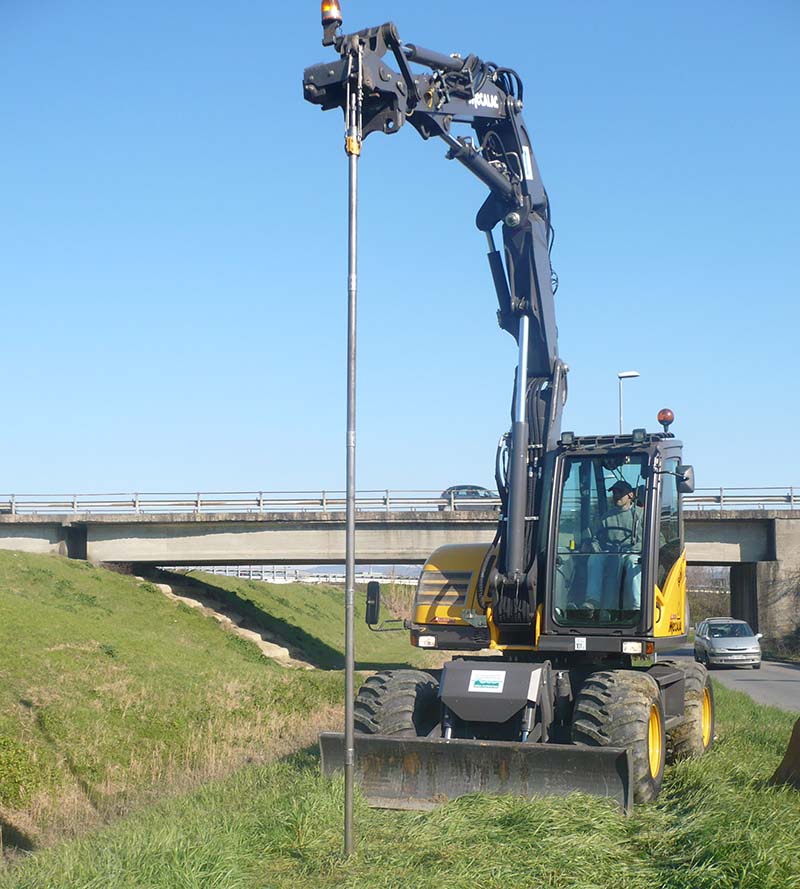
- Coring system (DUNE_LAB): The AF SHALLOW CORING SYSTEM is a continuous-core drilling system for granular and cohesive rocks, specifically engineered for quick coring, which has been successfully applied to obtain continuous cores for detailed stratigraphic studies. The use of a specially designed and engineered textile liner allows 100% recovery of the drilled sequence, with nil to negligible alteration of geotechnical parameters down to a depth of 10-12m. As far as we know, this system is at present the only coring system allowing 100% sample retrieval, even in saturated loose sands, as is the case of the lacustrine borders sediments. The relatively small attainable depth (max 10-12 m) represents the major limit of the AF SYSTEM methodology and it may restrict the interval of investigation. Nevertheless, we stress the fact that deeper cores obtained by all the other methods (for instance the Livingston piston corer) are discontinuous, since only 50-100cm of sediments are extracted in each coring operation. Therefore, the cores obtained are the sums of these short segments and are severely affected by both presence of re-worked material and duplication of the stratigraphic sequence, due to the absence of a liner protecting the open hole.
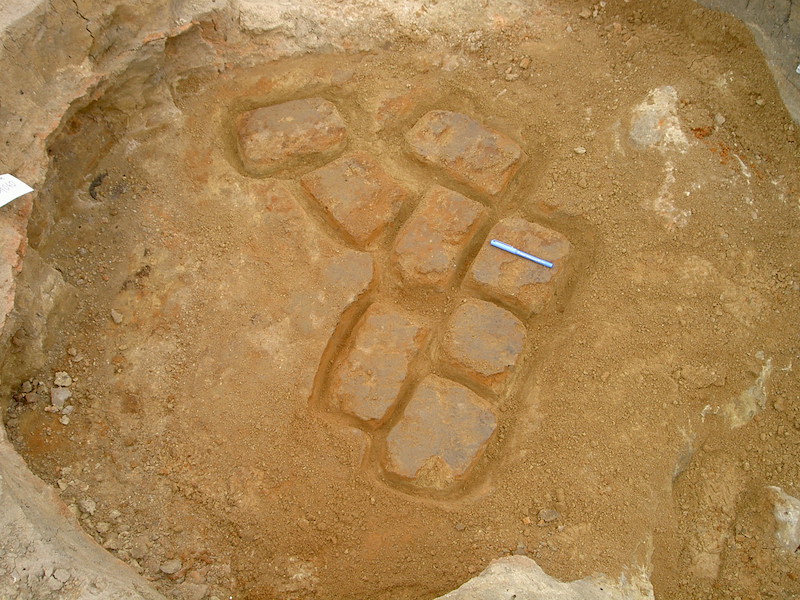
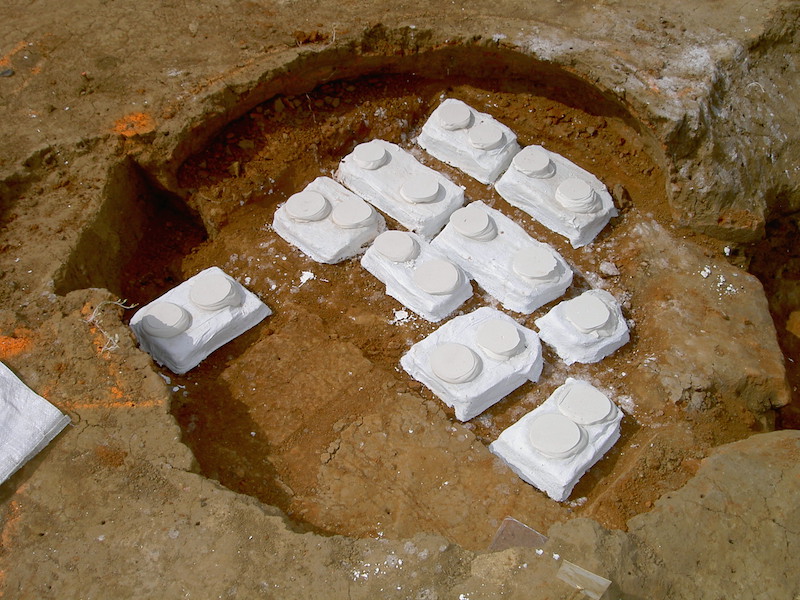
- Archaeomagnetic dating (Archaeo_LAB): Archaeomagnetism is a dating methodology based on the alignment of the magnetic vector inside object containing ferromagnetic materials, as baked clay, in pottery and furnaces and volcanic materials. These objects can yield the magnetic declination from the last time they were fired or used. In order to perform archaeomagnetic analyses, a number of samples are removed from the feature by encasement in non-magnetic plaster within non-magnetic molds. These samples are marked for true north at the time of collection. Each of the samples is measured in a large cell induction magnetometer, to determine its thermal remanent magnetization. The results are statistically processed and a vector is generated that shows orientation that will yield a location for the North Pole at the time of the last thermal event of the feature. Data from this feature is compared to the regional secular variation curve in order to determine the best-fit date range for the feature's last firing event.
Instruments
The equipment present in the laboratory includes:
Archeo-LAB:
- Induction Magnetometer with large cell
- Sampling sets for furnaces
- Sampling set for volcanics
- Conditioning set for sample with dimension 12x12x12cm
- Current generator
- Wooden shelves (42 linear meters) for stocking sample before analysis
Dune-LAB:
- AF_Topcore 40 (cores diameter 43mm)
- AF_Topcore 40 modified (core diameter 43 mm)
- AF_Topcore 20 (core diameter 33 mm)
- Cold room (2mx1.2m)
- Polarising Microscope LEICA
- 2 Binocular Microscopes
- Photo-stand (70x60cm)

Staff and Contacts
The staff of the isotopic chemical laboratory is composed of:
- Dr. Sonia La Felice (CNR Researcher – Laboratory Manager)
- Dr. Daniele Giordano (Research Associate)
- Dr. Claudia Principe (Research Associate)
- Dr. Marina Devidze (Research Associate)
Contacts:
- Dr. Sonia La Felice: 050 6212335, sonia.lafelice@igg.cnr.it
Methods and Applications
Archeo-LAB:
The lab use the precise dating method developed at Saint Maur des Fossés Laboratories from the Institut de Physique du Globe de Paris (IPGP), France (Thellier, 1981). Sampling and measurement procedures refer to the so-called “big sample plaster method” of Thellier (1981) for archaeological purposes and routinely applied in our laboratory with few modifications. Application of this methodology for dating of young volcanic products and archaeological samples, its advantages, and limitations are given in a huge literature (e.g. Tanguy et al., 2003, EPSL).
The sampling method involves the collection of several big samples, each weighing 0.5–1 kg, possibly distributed over some tens of meters. In the case of lavas, each block is first detached and then replaced in its original position. Plaster of appropriate fluidity is poured on the block, to support a plate carrying a spherical spirit level, thus making a horizontal surface 6–7 cm in diameter on which the sun shadow is marked for calculation of the geographical north. In the laboratory, the samples are re-plastered in square molds 12 cm in size. Measurements are performed by means of a large rotating induction magnetometer and an AF demagnetization device for big samples (Le Goff, 1975). The advantages of this method with respect to traditional core-drilling are the extremely precise orientation of the sample in the field and the possibility of obtaining high-precision data on lavas, welded scoriae, and high temperature-emplaced, non-welded, pyroclastic deposits (Hoblitt et al., 1985; Genevey et al., 2002). Another fundamental advantage is that the plaster method avoids the effect of any parasitic magnetization acquired during the drilling process (Lauer, 1978; Audunsson & Levi, 1989). Dating interval and accuracy depends on the precision of the continuously improving reference Geomagnetic Secular Variation Curve (Pavon-Carrasco et al, 2014).


Dune-LAB:
Si tratta di un sistema di carotaggio continuo e speditivo per rocce da granulari, fino a debolmente coerenti. E’ una metodologia particolarmente interessante per chi abbia necessità di un carotaggio continuo per l’esecuzione di studi microstratigrafici di precisione anche in località difficilmente raggiungibili (l’intera strumentazione può essere trasportata a spalla) e in caso di problemi ambientali (nessun inquinante o additivo chimico è inserito nel terreno). Il sistema di microcarotaggio superficiale AF è composto di scarpe taglienti di differente durezza e caratteristiche, aste di perforazione di acciaio speciale ultra leggere, una testa di carotaggio includente una cartuccia precaricata con una guaina tessile di diversa tipologia in funzione degli scopi del carotaggio e dei terreni da attraversare, un martello pneumatico adattato per l’infissione delle aste, ed un set di binde ed accorgimenti per l’estrazione. L’uso delle speciali guaine tessili facilita le operazioni di trasporto sul terreno e di apertura e conservazione dei carotaggi ottenuti. Il sistema permette l’estrazione di carote di sedimenti pressoché indisturbate dal punto di vista geotecnico. Le applicazioni di questo metodo, originariamente studiato da IGG-CNR per il recupero di depositi piroclastici in facies distale e in ambienti lacustri, sono molteplici, e vanno dalla geotecnica all’analisi dell’inquinamento ambientale, alla stratigrafia fino alla palinologia e idrogeologia.




Scientific Projects and Interests
Project:
- Progetto di ricerca (2012-16): “Monografia Vulcanologica del Monte Amiata, Toscana Meridionale” LAMMA-Regione Toscana.
- Short Therm Mobility (STM) (2015): “Evaluation of the volcanic hazard in El Hierro Island (Canary Islands, ES) – Geological mapping and chronostratigraphy” CNR – Direzione Attività Internazionali.
- Progetto Bilaterale CNR-SRNSF/Italia-Georgia (2014-15): “Geo-archaeology in Georgia and geomagnetic Secular Variation Curve (SVC) development for Caucasus area” CNR – Direzione Attività Internazionali.
- Short Therm Mobility (STM) (2013): “Time clustering, frequency, localization and extension of lavaflows at Teide and Vesuvius: a comparative and multidisciplinary investigation of emplacement features and mapping of the associated risk (Canary Islands, SP)” CNR – Direzione Attività Internazionali.
- Progetto bilaterale CNR-SRNSF/Italia-Georgia (2012-13): “Il contributo della Georgia alla costruzione di una Curva di Variazione geomagnetica Secolare per il Caucaso e la regione Circum-Mediterranea” CNR – Direzione Attività Internazionali.
- Progetto bilaterale CNR-CSIC/Italia-Spagna (2011-12): “Time clustering, frequency, localization and extension of lavaflows at Teide and Vesuvius: a comparative and multidisciplinary investigation of emplacement features and mapping of the associated risk” CNR – Direzione Attività Internazionali.
- Contratto di ricerca (2011): “1861 – Il Vesuvio celebra l’unità d’Italia” Banco di Napoli
- Contratto di ricerca “AITHALE” (2011): “Ricerche geo-archeologiche lungo il litorale di Portoferraio, Isola D’Elba” Comune di Portoferraio.
- Progetto “Alèa” (2011): “Pre-historic (< 4kyrs) explosive activity at Piton de la Fournaise volcano” IPGP-OVPDF and BRGM.
- Contratto di ricerca (2009): “Per l’acquisizione di dati conoscitivi relativi al patrimonio archeologico dell’Isola di Pianosa” Direzione Regionale per i Beni Culturali e Paesaggistici della Toscana.
- Contratto di ricerca (2008): “Studi per la definizione del patrimonio Archeologico. Modellizzazione tridimensionale degli orizzonti e delle strutture sepolte nell’area prospiciente Cala San Giovanni, Isola di Pianosa” Cooperativa San Giacomo di Porto Azzurro.
- Contratto di ricerca (2006): “Piano di Caratterizzazione ambientale finalizzato all’individuazione di valori chimici di riferimento per la movimentazione dei sedimenti dell’area di foce del fiume Cecina” ICRAM-CNR, ARPAT.
- Programma internazionale di cooperazione scientifica – PICS (2005-07): “Variation séculaire du champ géomagnetique en Europe de l’Ouest durant le 1er millénaire avant Jésus-Christ – Développer l’archeomagnetisme en Italie”.
Main scientific interests:
- Chronostratigraphy of recent volcanic areas.
- Archaeomagnetic dating of burned structures for the reconstruction of the Secular Geomagnetic Variation Curve (SVC) for the peri-Mediterranean region over the last 10-15,000 years.
- Sedimentological analysis and facies changes of deposits resulting from volcanic processes.
- Resolution and integration of stratigraphic and geophysical data for paleo-environmental reconstructions at sites of geological and archaeological interest.
Publications
- A Morandi, A Di Muro, C Principe, L Michon, G Leroi, F Norelli, P Bachelery (2016): Pre-historic (< 4kyrs) explosive activity at Piton de la Fournaise volcano. In Springer-Verlag Berlin Heidelberg 2016 P. Bachèlery et al. (eds), Active Volcanoes of the Southwest Indian Ocean, Active Volcanoes of the World, DOI 10.1007/978-3-642-31395-0_20
- E. M. Sánchez-Moreno, M. Calvo-Rathert, A. Gogichaishvili, G. T. Vashakidze, V. A. Lebedev, A. Carrancho, J. Villalaín, A. Caccavari, M. Devidze, C. Principe (2015): REGISTRO DE TRANSICIONES DE POLARIDAD EN COLADAS VOLCANICAS PLIOCENAS DE LA MESETA DE DJAVAKHETI (CÁUCASO MENOR): EL CASO DE LA SECUENCIA DE APNIA Latinmag Letters, Volume 5, Special Issue (2015), id number, 1-n, Proceedings São Paulo, Brasil
- C Principe, A Ghilardi, S Ducci, S Perazzi, G Grandinetti, M Firmati (2013): Indagini geoarcheologiche nell’area di Cala San Giovanni; in “PLANASIA, un Sistema Informativo Territoriale per la gestione dei Beni Culturali dell’Isola di Pianosa”, a cura di A Marino, A Negri, A Patera. Ministero per i Beni e le Attività Culturali. Edizioni ETS, Pisa pp 57-63
- Lorella Alderighi, Marco Benvenuti, Franco Cambi, Laura Chiarantini, Caterina X.H. Chiesa, Alessandro Corretti, Andrea Dini, Marco Firmati, Laura Pagliantini, Claudia Principe, Luisa Quaglia, Luisa Zito (2013): Aithale – Ricerche e scavi all’Isola d’Elba. Produzione siderurgica e territorio insulare nell’antichità. Annali della Scuola Normale Superiore di Pisa, Classe di Lettere e Filosofia, Rassegna Archeologica, Serie V, 2013, 5/2, Supplemento, pp. 169-189
- C Principe, S Arrighi, J Malfatti D Brocchini (2011): Datazione archeomagnetica di alcune fornaci dell’Isola d’Elba. In “Isola d’Elba – Atlante delle fornaci” (a cura di Fiorella Ramacogi) Soprintendenza per i Beni Architettonici, Paesaggistici, Storici, Artistici ed Etnoantropologici per le Province di Pisa e Livorno; BetaGamma editrice, 83-97.
- J Malfatti, C Principe, G Gattiglia (2011): Archaeomagnetic Directional Investigation of a Metallurgical Furnace in Pisa (Italy). Journal of Cultural Heritage; vol 12, 2011, 1-10.
- J Malfatti, C Principe, S Arrighi, C Arias (2009): L’archeomagnetismo per la datazione delle attività siderurgiche antiche. In Franco Cambi, Fernanda Cavari, Cynthia Mascione (a cura di), “MATERIALI DA COSTRUZIONE E PRODUZIONE DEL FERRO – Studi sull’economia populoniese fra periodo etrusco e romanizzazione”, Edipuglia, pg. 213-218
- JC Tanguy, M Le Goff, S Arrighi, C Principe, S La Delfa, G Patanè (2009): The history of Etna and Vesuvius revisited through Archeomagnetism. EOS vol 90, n.ro 40, 6 oct 2009, 349-350, ISSN: 0096-3941.
- L Vezzoli, C Principe, JC Tanguy, S Arrighi, M Le Goff, J Malfatti (2009): Modes and times of caldera resurgence: The <10 ka evolution of Ischia Caldera, Italy, from archaeomagnetic dating. Journal Volcanol Geotherm Res, 186, 305-319.
- C Principe, A Malfatti, M Ambrosio, MT Fagioli, M Rosi, B Ceccanti, S Arrighi, D Innamorati (2007): Finding distal Vesuvius tephra at the borders of Lago Grande di Monticchio, in AF SHALLOW CORING SYSTEM micro-cores. Proceedings of the Second International Conference on Soils and Archaeology, held in Pisa on 2003. Atti Soc. tosc. Sci. nat., Mem., Serie A, 112 (2007) pagg. 189-197.