
The Isotope Chemistry Laboratory is housed in the IGG Headquarters in the Pisa Research Area and conducts intense research aimed at numerous applications of isotope geochemistry techniques in the geochemical, hydrogeological, geothermal, and volcanological fields.
The Laboratory
The Isotope Chemistry Laboratory uses established techniques to determine the isotopic abundance of water molecules, carbonate rocks, gases, and dissolved inorganic carbon (DIC). The study of isotopes relies on their distribution in different phases (solid, liquid, gaseous) as tracers of the element's origin and the processes that influenced it. The analysis of these molecules allows us to highlight the potential interactions of the substances under study in environmental and anthropogenic matrices, with applications ranging from geology to environmental sciences to the medical field.
The instrumentation present in the laboratory allows the analysis of the isotopes of hydrogen (2H, 3H), carbon (13C) and oxygen (18O) in almost all the compounds in which they are present.
In the environmental field, isotopic analyses are primarily applied to the characterization of landfill leachate. The use of isotopic analysis techniques in the medical field has enabled diagnostic results, such as the detection of Helicobacter pylori, or the conducting of metabolic studies (Total Energy Expenditure, TEE). Collaboration in the medical field with the Institute of Clinical Physiology of the National Research Council (IFC), begun in 1998, led in 2013 to the establishment of a cross-laboratory between IFC and IGG (ENvironmental, Biological and ISotope Lab – ENBISL).
The Laboratory collaborates with universities, government agencies, consulting firms and other institutions.
Instruments
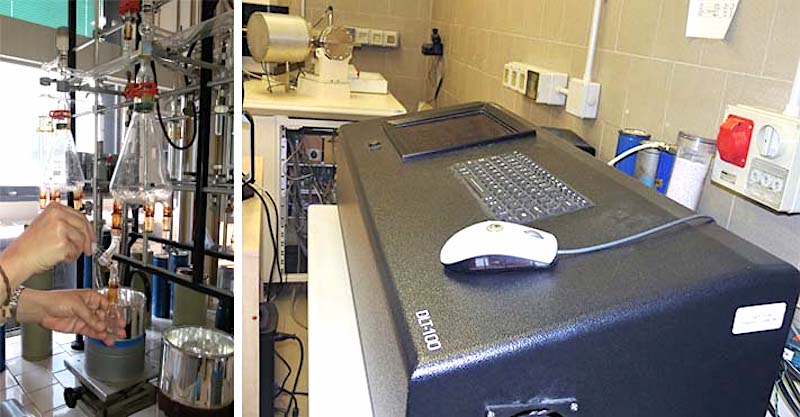
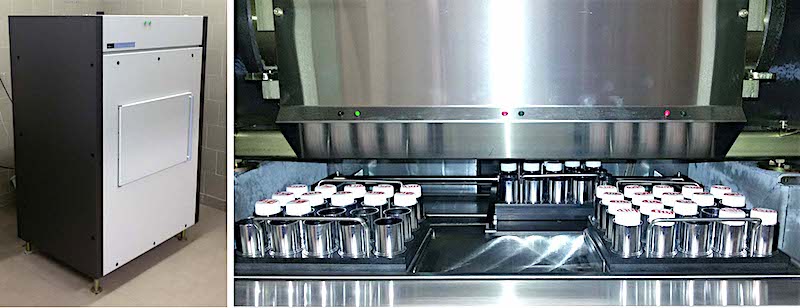
The equipment present in the laboratory includes:
- Two IRMS mass spectrometers (Europa Scientific Geo 2020 and Finnigan MAT252 in dual inlet configuration), for the isotopic analysis of CO2 and H2;
- The Los Gatos Research (LGR) Liquid Water Isotope Analyzer (LWIA) provides measurements of δ18O and δ2H in aqueous samples using laser spectroscopy. The instrument uses a technique based on Off-Axis Integrated Cavity Output Spectroscopy (OA-ICOS). This technique offers performance comparable to that of mass spectrometers and measures the absolute concentration of 2HHO, HH18O, and HHO molecules;
- Vacuum preparation lines that allow gas samples to be obtained for mass spectrometric isotopic composition measurement. These lines specifically focus on the analysis of oxygen-18 and deuterium in water, carbon-13 and oxygen-18 in carbonates, and dissolved carbon-13 in water;
- QUANTULUS™ liquid scintillation counter (PerkinElmer), capable of measuring low ambient levels of alpha and beta radiation;
- Thermostatted electrolysis bench for the tritium enrichment of natural waters using IAEA (International Atomic Energy Agency) type cells.

Staff and Contacts
The staff of the isotopic chemical laboratory is composed of:
- Dr. Brunella Raco (CNR Researcher – Laboratory Manager)
- Carlo Sardo (CNR Technician)
- Dr. Maurizio Catania (CNR Technician)
- Caterina Giorgi (CNR Technician)
Contacts:
- Dr. Brunella Raco: 050 6212320, brunella.raco@igg.cnr.it
Methods and Applications
The main methods used within the laboratory are derived from consolidated techniques, the main bibliographical references of which are reported below:
- Determination of the concentration of oxygen-18 in water. The procedure consists of equilibration with CO2, , after manual preparation on a vacuum line, and subsequent measurement of the isotopic composition using a mass spectrometer (Epstein S. and Mayeda T., 1953. Variation of 18O content of waters from natural sources. Geochimica et Cosmochimica Acta, v. 4, n. 5, 213-224)
- Simultaneous determination of deuterium and oxygen-18 in water using LWIA-LGR. The Liquid Water Isotope Analyzer (LWIA), based on the “Off-Axis Integrated Cavity Output Spectroscopy” (OA-ICOS) technique, represents an alternative to the use of mass spectrometry for the analysis of stable isotopes in water. This instrument provides simultaneous measurements of the D/H and 16O/18O ratios directly on H2O without converting H2O to H2, CO, or equilibrating H2/CO2 with water. Using a systematic sample analysis and a data normalization procedure, a measurement precision of 0.8‰ for 2H and 0.1‰ for18O. (Lis G., Wassenaar L.I. and Hendry M. J., 2008. High-Precision Laser Spectroscopy D/H and 18O/16O Measurements of Microliter Natural Water Samples. Anal. Chem., 80, 287-293)
- Determination of carbon-13 and oxygen-18 in carbonates by reaction with phosphoric acid, after manual preparation on a vacuum line, and measurement of the isotopic composition of the CO2 produced by mass spectrometry (McCrea JM, 1950. On the Isotopic Chemistry of Carbonates and a Paleotemperature Scale. The Journal of Chemical Physics, v. 18, n. 6, 849-857)
- Isotopic analysis of dissolved inorganic carbon (DIC) in water. This measurement is performed on CO2 extracted from the sample, obtained by acidifying the water with phosphoric acid. (Mook WG, 1970. Stable carbon and oxygen isotopes of natural waters in the Netherlands. Isotope Hydrology, IAEA, Vienna, 163-190)
- Determination of tritium in water by direct measurement of the sample (when the water contains more than 60 UT), or by electrolytic enrichment of the sample for waters with low content using the QUANTULUS™ liquid scintillation counter. Liquid scintillation counting is based on the conversion of the energy of a particle emitted by a radioactive nucleus into light energy by a scintillating chemical substance in which the radioactive sample is in solution. (Thatcher LL, Janzer VJ and Edwards RW, 1977. Methods for determination of radioactive substances in water and fluvial sediments. In: Techniques of Water Resources Investigations. US Geol. Surv., Washington, pp. 79–81)
- This type of isotopic analysis finds application in various fields, including: geothermal energy, volcanology, hydrogeology, hydrology, environmental sciences and medicine.
Scientific Projects and Interests
The laboratory performs certified analytical activities on behalf of third parties and as part of contracts, agreements, and research collaborations with numerous national and international companies, universities, and institutions, including:
- Enel Green Power (gruppo ENEL) – Pisa;
- International Atomic Energy Agency (I.A.E.A.) – Vienna;
- AQUATER (gruppo ENI) – San Lorenzo in Campo (PS);
- U.S.G.S. – U.S.A.;
- Università di Napoli, Dipartimento di Scienze della Terra;
- Università di Pisa, Dipartimento di Scienze della Terra;
- Università di Roma “La Sapienza”, Dipartimento di Scienze della Terra;
- Università di Ancona, Dipartimento di Fisica e Ingegneria dei Materiali e del Territorio;
- Università di Perugia, Dipartimento di Ingegneria Civile e Ambientale;
- Università di Perugia, Dipartimento di Scienze della Terra;
- Università di Bologna, Dipartimento di Scienze della Terra e Geologico-Ambientali;
- Università di Torino, Dipartimento di Scienze della Terra;
- Università di Firenze, Dipartimento di Scienze della Terra;
- Università di Sassari, Istituto di Scienze Geologico-Mineralogico;
- Università di Modena, Dipartimento di Scienze della Terra;
- Politecnico di Torino, Dipartimento Georisorse e Territorio;
- Terme di Manzano – Cortona (AR);
- CEPA s.r.l. – Palermo;
- Fiorentinambiente – Firenze;
- Progeo s.r.l. – Pisa;
- I.G.M.E. – Atene;
- G.E.M.E.E. – Atene;
- CESEN S.p.A. – Genova;
- S.Te.G.A. – Viterbo;
- Terme di Saturnia s.r.l. – Saturnia (GR);
- GEO s.r.l. – Bari;
- COINFRA consorzio infrastrutture – Prato;
- Cierre s.n.c. – Arezzo;
- Singea s.r.l. – Ravenna;
- Geotecno – Firenze;
- Crippa & Bergher fonti Levissima S.p.A.– Sondrio;
- Museo Nacional de Ciencis Naturales – Madrid;
- Ministero delle Attività Produttive – Roma;
- ELC Electroconsult – Milano;
- Rocchetta S.p.A. – Gualdo Tadino (PG);
- PNOC – Manila (Filippine);
- Istituto Nacional Electrificacion – Guatemala;
- Ambiente s.c.r.l. – Carrara (MS);
- C.E.L. – San Salvador (El Salvador);
- Geotermica Italiana – Pisa;
- ARPAT – Siena;
- Consorzio Acquedotti Perugia S.p.A. – Perugia;
- Solvay Chimica Italia – Rosignano Solvay (LI);
- Analisi Service Pontedera (PI);
- Consorzio Pisa Ricerche – Pisa;
- Sodez SA – Corsica, Francia;
- AFE S.p.A. – Alessandria;
- San Pellegrino – San Pellegrino Terme (BG);
- Controlli Sicurezza Ambientale sas – Prato;
- R.A.I.T. s.r.l. – Roccapiemonte, Salerno;
- Sardinia Gold Mining S.p.A. – Cagliari;
- Amministrazione Provinciale – Sassari;
- San Martino Codrongianos – Sassari;
- Dip. Te. Ris. – Università di Genova;
- Fonte Azzurrina S.p.A. – Lucca;
- Italfilo – Grosseto;
- Hydrodata S.p.A. – Torino;
- Panna S.p.A. – Scarperia (FI);
- Azienda Municipalizzata Nettezza Urbana S.p.A. – Parma;
- Istituto De Investigationes Electricas, Dept. De Geotermia – Messico;
- Comunità Montana dell’Elba e Capraia – Livorno;
- SIAMI s.r.l. – Gubbio (PG);
- Messer Geogas s.r.l. – Rapolano Terme (SI);
- Centro Studi Geologici, Geologia Tecnica – S. Miniato B. Pisa;
- Institute of Geology and Mineral Exploration (IGME) – Atene Grecia;
- Aeronautica Militare – Genova;
- HSYI s.r.l. – Torino; ASA – Livorno;
- Caffaro Energia s.r.l. – Sesto San Giovanni (MI);
- Getas-Petrogeo s.r.l. – Pisa;
- TEA sistemi – Pisa.
Main scientific interests include:
- Geochemistry and hydrogeology (isotopic characterization of precipitation and groundwater, dynamics of underground water flows, identification of interaction processes between superficial and deep aquifers, aquifer dating);
- Geothermal energy and volcanology (geothermometric applications, study of fumarolic fields);
- Paleoclimate and paleohydrology (determination of the isotopic composition of oxygen and carbon on foraminifera for the reconstruction of the climatic conditions and paleocirculation of the Adriatic sector in the late Quaternary);
- Biology (studies on human metabolism, liver activity and diagnostic tests);
- Environmental monitoring (evaluation of the level of contamination of drinking water aquifers, studies on the formation and dispersion processes of leachate and biogas in landfills).
Publications
- Cortopassi P., D’Amato Avanzi G., Guidotti M., Marconi C., Milano P.F., Mussi M., Puccinelli A. (2006) Approccio multidisciplinare per la valutazione della pericolosità di frana: indagini geologico-tecniche, idrogeologiche, geochimiche e isotopiche per la determinazione degli apporti idrici sotterranei nella frana di Cassana in Val di Magra (Massa-Carrara, Italia). Giornale di Geologia Applicata, Vol. 3, pp. 196- 204.
- Cortecci G., Boschetti T., Mussi M., Lameli C.H., Mucchino C., Barbieri M. (2005) New chemical and original isotopic data on waters from El Tatio geothermal field, northern Chile. Geochemical Journal, Vol. 39, pp. 547- 571.
- Mussi M. (2004) Gli isotopi ambientali nelle acque di sorgenti e pozzi e nelle emergenze sulfuree sottomarine di Capo Palinuro, Salerno. Geologia Tecnica & Ambientale, Vol. 3, pp. 35 – 55.
- Calvi E., Caprai A., Leone G., Mussi M. (1999) Isotopic and chemical compositions of some thermal groundwaters and associated gases in the Serchio river valley, Northern Tuscany, Italy. Atti Soc. tosc. Sci. nat., Mem., Serie A, vol. 106 (1999), pagg. 45-53.
- Mussi M., Leone G., Nardi I. (1998) Isotopic geochemistry of natural water from the Alpi Apuane-Garfagnana area, Northern Tuscany, Italy. Miner. Petrogr. Acta, vol. XLI, pp. 163-178.
- Gianelli G., Ruggieri G., Mussi M. (1997) Isotopic and fluid inclusion study of hydrothermal and metamorphic carbonates in the Larderello geothermal field and surrounding areas, Italy. Geothermics vol. 26, n. 3, pp. 393-417.
- Grassi S., Kolios N., Mussi M., Saradeas A. (1996) Groundwater circulation in the Nea Kassani low-temperature geothermal field (NE Greece). Geothermics vol. 25, n. 2, pp. 231-247.
- Tenu A., Davidescu F., Squarci P., Mussi M. (1995) A low enthalpy geothermal system in the moesian platform. Proceedings of the World Geothermal Congress, Firenze 18-31 maggio 1995, vol. 2, pp. 1325-1329.
- Grassi S., Squarci P., D’Amore F., Mussi M. (1995) Circulation of thermal waters on Pantelleria Island (Sicily Channel, Italy). Proceedings of the World Geothermal Congress, Firenze 18-31 maggio 1995, vol. 2, pp. 703-706.
- Squarci P., Gianelli G., Grassi S., Mussi M., D’Amore F. (1994) Preliminary results of geothermal prospecting on the Island of Pantelleria. Acta Vulcanologica, vol. 5, pp. 117-123.
- D’Amore F., Fancelli R., Mussi M., Caprai A. (1988) Gas modelling in geothermal system using carbon monoxide measurements. Rendiconti SIMP “In memory of Marcello Carapezza 1925-1987” vol. 43, n. 4, pp. 1013-1020.
- Raco B., Mussi M., Doveri M., Lelli M., Calvi E., Catania M., Cervelli M., Ferrari E., Giorgi C., Trifirò S. (2007) Studio idrogeochimico sulla rete di monitoraggio della discarica RSU di Legoli (Comune di Peccioli, PI) e sui corpi idrici circostanti. Rapporto Finale CNR-IGG, nell’ambito della Convenzione di Ricerca tra CNR-IGG e Belvedere S.p.A. del 11/10/2006 protocollo CNR-IGG 0002430, 25 pp.
- Mussi M., Doveri M., Calvi E., Catania M., Ferrari E., Giorgi C., Giorgi R. Trifirò S. (2006) Discarica di Casa Sartori (Comune di Montespertoli – FI): Indagine isotopica sui percolati e le acque di tre piezometri (prelievo del 26 novembre 2006 ad integrazione della prima indagine di cui alla relazione del 30/10/2006). Rapporto Scientifico Riservato CNR-IGG, commissionato da Publiambiente S.p.A., 13 pp.
- Mussi M. (1995) Contenuti isotopici delle acque provenienti dalla concessione Rocchetta S.p.A., Comune di Gualdo Tadino (PG) e campionate il 22 febbraio 1995. Rapporto Scientifico Riservato CNR-IIRG, commissionato da Rocchetta S.p.A., 14 pp.
- Mussi M. (1993) Contenuti isotopici delle acque provenienti dalla concessione Panna S.p.A., Comune di Scarperia (FI). Rapporto Scientifico Riservato CNR-IIRG, commissionato da Panna S.p.A., 27 pp.
- Mussi M. (1992) Interpretazione isotopica dei risultati dell’analisi del contenuto in Deuterio, Ossigeno-18 e Tritio in cinque campioni di acqua provenienti da alcune sorgenti delle fonti Levissima S.p.A. (Cepina Valdisotto). Rapporto Scientifico Riservato CNR-IIRG, commissionato da Crippa & Bergher Fonti Levissima S.p.A., 14 pp.
- Mussi M. (1989) Interpretazione isotopica dei risultati dell’analisi del contenuto in Deuterio, Ossigeno 18 e Tritio dei due campioni di acque provenienti dalle terme di Manzano (Comune di Cortona). Rapporto Scientifico Riservato CNR-IIRG, commissionato dalla società GEOTECNO di Firenze, 3 pp.
- D’Amore F., Fancelli R., Mussi M., Saracco L., Truesdell A.H., Caprai A., Calvi E., Del Chicca G., Giorgi R. (1988) Development of a methodology for measuring carbon monoxide and its geothermometric applications. Final Report 1986-88, contratto CEE-CNR (IIRG) n° EN3G-0022-I, 34 pp.