
The assessment of the surface heat flux (HF) distribution is a fundamental element in geothermal prospecting methods, allowing the identification of thermally anomalous areas at relatively modest costs and providing an immediate indication of the geothermal potential of an area.
The Laboratory
Thermal geothermal exploration methods (well temperature measurements and calculation of geothermal gradients; thermal conductivity measurements on rock samples) are, moreover, the only ones that allow a direct measurement of the quantity “heat” which is the ultimate goal of exploration.
The product of the geothermal gradient value of an area (∆t/∆z) by that of the thermal conductivity of the rocks (k) gives the value of the heat flux (Q), according to the relation:
Q = k x ∆t/∆z (Q = mWxm-2).
The main product of the laboratory's activity is the heat flow and/or geothermal gradient maps of the investigated area.
These maps represent the basis of geothermal exploration. However, depending on data availability and the study's objectives, different combinations of direct comparisons of HF with other geophysical, geochemical, and structural parameters are possible, allowing for a comprehensive view of an area's geothermal characteristics. They provide fundamental information on the physical and chemical nature of fluids present in the past in various geological environments. The primary analytical method is microthermometric analysis, based on the temperatures at which phase transitions occur within fluid inclusions. Fluid inclusion analyses are commonly used in the study and prospecting of mineral deposits, geothermal exploration, and petroleum exploration; in metamorphic, magmatic, and sedimentary petrology; and in research on the relationships between fluid circulation and tectonic structures, etc.


Instruments
Currently, a manually operated instrument with a 450 m long, four-conductor, Teflon-coated cable is available for in-well temperature measurements; the acquisition sensor consists of a 100 Ohm nominal Pt100 platinum resistance thermometer, with a sensitivity of +/- 0.01 °C and an accuracy of +/- 0.03 °C. The “Corradi RP 2000 S” temperature control and indicator instrument is also available.
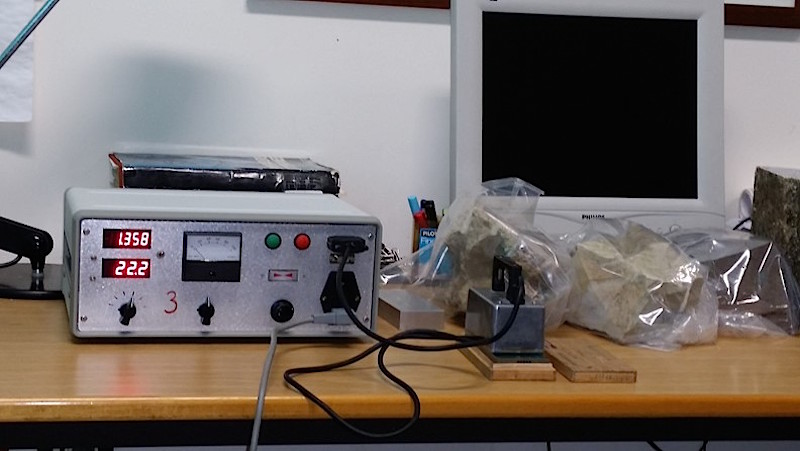
Thermal conductivity is measured in the laboratory on core samples taken from wells or rock outcrops. The samples are prepared in the IGG Rock Grinding and Mineral Separation Laboratory.
There are two linear source instruments available:
- Shotherm QTM Showa Denko;
- Self-built instrument in collaboration between IGG and IPCF CNR, with characteristics similar to the Shotherm QTM;
- An Isomet 2114 instrument is also available, alternatively equipped with a planar source or a Maxwell needle probe.
The following codes are used for thermal modelling of the studied areas:
- USGS Hydrotherm 3.1 (2D);
Shemat 7.1 (2D–3D) (University of Aachen).
For contouring and thermal section and graphing: - SURFER 13© (Golden Software);
GRAPHER 11© (Golden Software);
DIDGER 4© (Golden Software).



Staff and Contacts
The staff of the isotopic chemical laboratory is composed of:
- Dr. Stefano Bellani (CNR Researcher – Head of Laboratory, Pisa headquarter)
- Dr. Gianluca Gola (CNR Researcher – Head of Laboratory, Turin UOS)
Contacts:
- +39 050 6213286 (Dr. Stefano Bellani)
- +39 3805038398 (Dr. Gianluca Gola)
Methods and Applications
Microthermometric analyses are at the base of all fluid inclusion study. Microthermometry is carried out by using a heating/cooling stage mounted on an optical microscope, trough which is possible to observe and record the temperature of phase changes that take place in the fluid inclusions during controlled thermal cycles. On the basis of the recorded temperatures it is possible to obtain information on some chemical-physical parameters of the trapped fluids, for example: the salinity and the molar volume of aqueous solutions, the presence of CO2 (and sometimes CH4 and/or N2) in the fluids, the molar volume of fluid inclusions containing exclusively CO2 or CH4 or N2Furthermore, by integrating the microthermometric information with data obtained by RAMAN micro-spectroscopy, it is possible to reconstruct the temperature changes in the inclusions. In addition to calculating heat flow and geothermal gradients, precision well temperature measurements also have other applications in the earth sciences. This laboratory has conducted and continues to conduct activities in the identification and monitoring of groundwater aquifers, including in mining (underground rock salt mines), and in paleoclimate reconstructions using data from wells whose temperatures do not show evidence of groundwater circulation. Another field in which measuring terrestrial heat flow and geothermal gradients is of fundamental importance is that of medium- to low-enthalpy geothermal applications, a rapidly expanding sector for reasons of energy saving and environmental protection.
The results of the field (well measurements) and laboratory (thermal conductivity measurements) activities are integrated with other parameters and processed with 2D and 3D thermal modeling performed with the calculation codes Hydrotherm 3.1 (USGS) and Shemat 8.0 (University of Aachen). In collaboration with colleagues at IGG and foreign universities, thermal modeling was carried out with more complex codes (TOUGH2). This provides information on the composition and molar volume of aqueous solutions containing volatile phases (CO2 and/or CH4 and/or N2).


Scientific Projects and Interests
Most of the laboratory's activities are conducted in collaboration with research institutions and industries. The latter also represent the main source of funding.
Among others, but not limited to, collaborations have been and/or are active with:
Industry:
- ENEL
- Solvay Chemical Company
- Steam
- Sorgenia.
Research institutions:
- INGV
- Southern Methodist University (Dallas, USA)
- Universities of Trieste, Genoa, Rome, Bologna, Lugano (CH).
The laboratory is also currently involved in the “Horizon 2020 – DESCRAMBLE (2015-2018)” project for deep drilling in the Larderello geothermal field.
Publications
- Bellani S., Magro G., Gherardi F. (2015). “Heat Flow and Helium Isotopes in the Geothermal Areas of Tuscany (Central Italy)”. Geothermal Resources Council Transactions, vol. 39, p. 399-405.
- Bellani S., Gherardi F. (2014). “Thermal Features of the Pisa Plain, a Neogenic Basin in Central Italy”. –Geothermal Resources Council Transactions, vol. 38, p. 357-361.
- Bellani S., Gherardi F. (2013). “Thermal Overview of an Area NW of the Larderello Geothermal Field, Italy”. – Geothermal Resources Council Transactions, vol. 37, p. 231-235.
- Magro G., Gherardi F., Bellani S. (2010): “Noble gases in karstic and thermal waters of Strimon basin (Greece-Bulgaria)”. Water-Rock Interaction Symposium, Guanajuato, Mexico, p. 345-348.
- Bellani S., Gherardi F. (2009). “Thermal Modeling of an Area West of the Mt. Amiata Geothermal Field, Italy”. – Geothermal Resources Council Transactions, vol. 33, p. 431-435.
- Magro G., Bellani S., Della Vedova B. (2009). “The deep roots of the Larderello geothermal field (Italy) from heat flux and 3He anomalies”. Geothermal Resources Council Transactions, vol. 33, p. 405-409.
- Della Vedova B., Vecellio C., Bellani S., Tinivella U.,(2008). “Thermal modelling of the Larderello geothermal field (Tuscany, Italy)”. Int. Journal of Earth Sciences, 97, 317-332.
- Pasquale V., Verdoya M., Chiozzi P., Bodri L., Bellani S. (2005) “Temperature signal in the underground for climate history reconstruction in Italy”. Global and Planetary Change, 47. pp. 36-50
- Bellani S., G. Magro, A. Brogi, A. Lazzarotto and D. Liotta, (2005). “Insights into the Larderello geothermal field: structural setting and distribution of thermal and 3He anomaly”. Proceedings of World Geothermal Congress, Antalya, Turkey, 24-29 April 2005. pp. 1-4.
- Bellani S., Brogi A., Lazzarotto A., Liotta D., Ranalli G. (2004) “Heat flow, deep temperatures and extensional structures in the Larderello geothermal field (Italy): constraints on geothermal fluid flow”. Journal of Volcanology and Geothermal Research, 132, 15-29.
- Magro G., Gianelli G., Ruggieri G., Bellani S., Scandiffio G. (2003) – “Helium isotopes in paleofluids and present-day fluids of the Larderello geothermal field: Constraints on the heat source”. Journal of Geophysical Research, v. 108, n. B1, ECV3, 1-12.
- Della Vedova B., Bellani S., Pellis G., Squarci P. (2001) – “Chapter 7: Deep temperatures and surface heat flow distribution”. In: Anatomy of an orogen, The Apennines and adjacent Mediterranean basins, (Editors : Vai G.B., Martini I.P.). Kluwer Acad. Publ., Dordrecht, The Netherlands, pp. 65-76 + 2 plates.
- Bellani S., Buonasorte G., Grassi S., Squarci P. (1998): “Geological and structural features of the San Cataldo district heating project (Pisa, Italy)”. – Proceedings 5th World Renewable Energy Congress, Florence, Vol. 4, pp. 2746-2749.
- Baldi P., Bellani S., Buonasorte G., Fiordelisi A., Manzella A. (1998): “Geothermal exploration in Tuscany (Italy) for high temperature resources.” – Proceedings 5th World Renewable Energy Congress, Florence, Vol. 4, pp., 2733-2736.
- Wisian K.W., Blackwell D.D., Bellani S., Henfling J.A., Normann R.A., Lysne P.C., Forster A., Schrotter J. (1998): “Field comparison of conventional and new technology temperature logging systems” – Geothermics, Vol. 27, n.2, pp. 131-141.
- Wisian K.W., Blackwell D.D., Bellani S., Henfling J.A., Normann R.A., Lysne P.C., Forster A., Schrotter J. (1996): “How hot is it ? (A comparison of advanced technology temperature logging systems)” – Geothermal Resources Council Transactions Vol. 20, pp. 427-434
- Baldi P., Bellani S., Ceccarelli A., Fiordelisi A., Squarci P., Taffi L. (1995) : “Geothermal anomalies and structural features of southern Tuscany” – “World Geothermal Congress Proceedings”- Florence, May 1995, pp. 1287-1291.
- Bellani S., Grassi S., Squarci P.(1995) : “Geothermal characteristics of the Pisa plain” – “World Geothermal Congress Proceedings” – Florence, May 1995, pp. 1305-1308.
- Bellani S., Calore C., Grassi S., Squarci P. (1995): “Thermal prospecting in Pantelleria island (Sicily Channel, Italy)” – “World Geothermal Congress Proceedings” – Florence, May 1995, pp. 767-770.