
The fluid inclusion analysis laboratory is housed in the headquarter of the IGG Pavia UOS and is responsible for analyzing in situ the concentrations, at trace and minor levels, of elements from Li to U contained in small volumes of silicates, carbonates, phosphates and oxides.
The Laboratory
The LA-ICP-MS (LASER-ABLATION INDUCTIVELY-COUPLED-PLASMA MASS-SPECTROMETRY) methodology allows for the in situ analysis of trace and minor concentrations of elements from Li to U contained in small volumes of silicates, carbonates, phosphates, and oxides. This technique has countless applications in various fields, including:
- Geological and Planetary Geology (minerals, glasses)
- Environmental & Human Health (shells, otoliths, teeth, wood)
- Archaeometric (glass, ceramics, bricks, alloys)
- Industrial material (glass, alloys)
Similarly, in situ characterization of U-Th-Pb isotopic composition is performed for geochronological purposes on a wide range of minerals, particularly silicates (zircon and titanite), phosphates (monazite), and oxides (badelleite, rutile). Geochronological analyses can also be conducted on separate rock sections or directly on rock sections, preserving the textural context.

Instruments
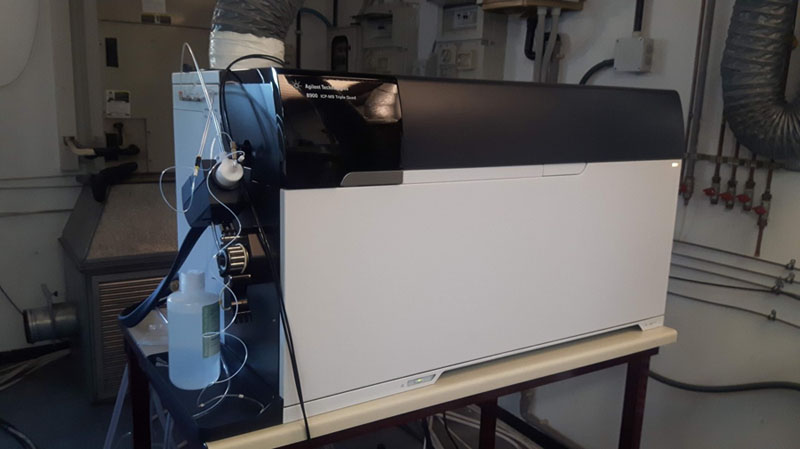
The LA-ICP-MS laboratory in Pavia is equipped with:
- three mass spectrometers
- one with a magnetic sector and double focusing (Element I, ThermoFinnigan)
- a triple quadrupole (8900 QQQ, Agilent)
- one of triple quadrupole (DRCe, Perkin-Elmer)
- three laser microprobes:
- two with solid-state ND:YAG sources with wavelengths of 266nm (Brilliant, Quantel) and 213nm (New Wave Research)
- an excimer one (mixture of Ar and F) with a wavelength of 193nm (Geolas102, Microlas).
The laboratory is also equipped with a Philips 515 scanning electron microscope (SEM) on which a scintillator detector is installed for cathodolumiscence imaging (standard photomultiplier at 300-650nm) of zirconia in mounts (separate, mounted on a 1-inch cylindrical support, embedded and polished) and/or directly in thin section.

Staff and Contacts
The staff of the isotopic chemical laboratory is composed of:
- Dr. Alberto Zanetti (CNR Research Director – Laboratory Manager)
- Marco Palenzona (CNR Technician)
Contacts:
- Dr. Alberto Zanetti: +39 0382 985867 (Office)
- Marco Palenzona: +39 0382 985798/797
- email: alberto.zanetti@cnr.it
- email:marco.palenzona@cnr.it
Methods and Applications
The LA-ICP-MS laboratory in Pavia was designed and equipped to conduct elemental and isotopic analyses of small volumes (a few cubic microns) of solid matrices, and therefore finds many applications in earth sciences and biology.
The laboratory conducts U-Th-Pb geochronological analyses of accessory minerals such as zircon and monazite, as well as rutile, titanite, and badelleite. The aim of these analyses is to provide temporal constraints on the crystallization of rocks or their tectonic-metamorphic evolution. Geochronological dating is also performed on sedimentary rock samples for provenance studies.
The LA-ICP-MS laboratory in Pavia conducts analyses of trace element concentrations (from Li to U) in natural and/or synthetic solid materials. The laboratory boasts decades of experience determining trace elements in rock-forming minerals, extraterrestrial materials, volcanic glass, gems, bioconstructed carbonates (otoliths, shells, etc.), and synthetic materials such as glass and ceramics, both recent and ancient. In recent years, the laboratory has also acquired considerable experience determining trace elements (primarily heavy metals) in bones, teeth, and wood (e.g., tree rings).
LA-ICP-MS analyses can be performed on thin rock sections, preferably >30 μm thick, or on separate sections embedded in epoxy resin cylinders 1 or 2 inches in diameter and 0.5 cm thick. The analytical spot size can range from 5 to 100 microns in diameter.


Scientific Projects and Interests
Project:
Over the last 10 years, researchers at the LA-ICP-MS laboratory in Pavia have received funding as proposers of or participants in scientific projects such as: MIUR – PRIN (2005; 2007; 2009; 2015; 2017), PNRA (2010; 2013), bilateral projects between CNR and CONICET (Argentina; 2013-2014), CARIPLO projects (2013), MEXT projects (Ministry of Science and Technology of Japan). Furthermore, the laboratory has received funding from scientific-technical applied projects, in particular dedicated to the determination of asbestos content in green stones.
The laboratory members are involved in ongoing scientific projects concerning the tectonic-magmatic evolution of the Ivrea-Verbano Zone (CNR-CNRS and ICDP 2015 projects) and investigations of the oceanic lithosphere (IODP projects).
Scientific interests:
- Mantle Petrology
- U-Th-Pb geochronology and petrology of crystalline basement rocks
- Magmatic processes in the lower crust
- Extraterrestrial material
One of the study sites of the IMAGE project is the quartz-tourmaline vein system of Monte Calamita (Elba Island, Italy), which represents an exhumed fossil hydrothermal system similar to the one that is thought to exist in the Larderello subsurface beneath the currently exploited system. (A) Sampling of the quartz-tourmaline veins; (B) Detail of a quartz-tourmaline vein; (C) Two-phase inclusion (liquid + vapor) in the quartz of the vein; (D) Multi-phase inclusion (liquid + vapor + halite (H) + 3 solids (S2, S3, S6)) in the quartz of the vein.


Publications
- Langone A., Zanetti A., Daczko N., Piazolo S., Tiepolo M., Mazzucchelli M. (2017) – Zircon U-Pb dating of a lower crustal shear zone: a case study from the northern sector of the Ivrea-Verbano Zone (Val Cannobina, Italy). Tectonics, DOI: 10.1002/2017TC004638.
- Tommasi A., Langone A., Padrón-Navarta J.A., Zanetti A., Vauchez A. (2017) – Hydrous melts weaken the mantle, crystallization of pargasite and phlogopite does not: Insights from a petrostructural study of the Finero peridotites, southern Alps. Earth and Planetary Science Letters 477, 59-72.
- Langone A., Padrón-Navarta J.A., Ji W.Q., Zanetti A., Mazzucchelli M., Tiepolo M., Giovanardi T., Bonazzi M. (2017) – Ductile–brittle deformation effects on crystal-chemistry and U–Pb ages ofmagmatic and metasomatic zircons from a dyke of the Finero MaficComplex (Ivrea–Verbano Zone, Italian Alps). Lithos, 284-285, 493-511.
- Zanetti A.; Giovanardi T.; Langone A.; Tiepolo M.; Wu F.-Y.; Dallai L.; Mazzucchelli M. (2016) – Origin and age of zircon-bearing chromitite layers from the Finero phlogopite peridotite (Ivrea-Verbano Zone, Western Alps) and geodynamic consequences. Lithos 10.1016/j.lithos.2016.06.015.
- Langone A. & Tiepolo M. (2015) – U-Th-Pb multi-phase approach to the study of crystalline basement : application to the northernmost sector of the Ivrea-Verbano Zone (Alps). Periodico di Mineralogia, 84, 3B, 633-655. http://dx.doi.org/10.2451/2015pm435.
- Zanetti A., Mazzucchelli M., Sinigoi S., Giovanardi T., Peressini G., Fanning M. (2013). SHRIMP U-Pb ZirconTriassic Intrusion Age of the Finero Mafic Complex (Ivrea-Verbano Zone, Western Alps) and its Geodynamic Implications. Journal of Petrology, 54(11), 2225-2265. doi:10.1093/petrology/egt051.
- Tribuzio R., Renna M.R., Dallai L., Zanetti A. (2014). The magmatic–hydrothermal transition in the lower oceanic crust: Clues from the Ligurian ophiolites, Italy. Geochimica et Cosmochimica Acta, 130, 188–211. http://dx.doi.org/10.1016/j.gca.2014.01.010.
- Borghini G., Rampone E., Zanetti A., Class C., Cipriani A., Hofmann A.W., Goldstein S.L. (2013). Meter-scale Nd isotopic heterogeneity in pyroxenite-bearing Ligurian peridotites encompasses global-scale upper mantle variability. Geology, 41, 1055-1058. doi: 10.1130/G34438.1.
- Ziberna L., Nimis P., Zanetti A., Marzoli A. and Sobolev N.V. (2013). Metasomatic Processes in the Central Siberian Cratonic Mantle: Evidence from Garnet Xenocrysts from the Zagadochnaya Kimberlite. Journal of Petrology, 54(11), 2379-2409. doi:10.1093/petrology/egt051.
- Miller C., Zanetti A., Thöni M., Konzett J., Klötzli U. (2012). Mafic and silica-rich glasses in mantle xenoliths from Wau-en-Namus, Libya: Textural and geochemical evidence for peridotite–melt reactions. Lithos, 128, 11-26. doi:10.1016/j.lithos.2011.11.004.
- Guarnieri L., Nakamura E., Piccardo G.B., Sakaguchi C., Shimizu N., Vannucci R., Zanetti A. (2012). Petrology, Trace Element and Sr, Nd, Hf Isotope Geochemistry of the North Lanzo Peridotite Massif (Western Alps, Italy). Journal of Petrology, 53 (11), 2259-2306. doi:10.1093/petrology/egs049.
- Aldanondo N., Cotano U., Tiepolo M., Boyra G., and Irigoien X. (2010). Growth and movement anchovy (Engraulis encrasicolus L.) in the Bay of Biscay based on otolith microstructure and chemistry. Fish. Oceanogr. 19:3, 196–208, 2010.
- Folco L., Rochette P., Perchiazzi N., D’Orazio M., Laurenzi M.A., Tiepolo M (2008). Microtektites from Victoria Land Transantarctic Mountains. Geology, 36; 291–294; doi: 10.1130/G24528A.1.
- Tiepolo M., Bottazzi P., Palenzona M. and Vannucci R. (2003) A laser probe coupled with ICP – double-focusing sector-field mass spectrometer for in situ analysis of geological samples and U-Pb dating of zircon. Can. Mineral. 41, 259-272. http://www.canmin.org/content/41/2/259.full.pdf+html.